
This article is part of a collaborative series created with Amazon Signage, exploring how digital signage can help businesses communicate more effectively across different industries. In this instalment, we look at hospitality, from QSR menu boards to hotel digital concierges, and how Xibo and the Amazon Signage Stick are making these applications more accessible and simple to use for smaller businesses.
Hospitality teams carry more communication load than almost any other frontline workforce. Front-desk staff repeat the same directions, restaurant reservations and local recommendations dozens of times a shift. Restaurant teams answer the same questions about menu options, wait times and specials. Housekeeping and maintenance work around printed notices that need updating whenever anything changes. The pressure is constant, and every question a team member answers is a moment they aren't spending on the interactions that actually matter.
Digital signage for hospitality takes a real share of that load off the team by putting the information guests need in the spaces they already look at. A well-placed display can answer the question a guest was about to ask, promote the amenity they didn't know existed, and keep menu and, event listings current without anyone touching a printed sign. For SMB hospitality businesses, the practical result is a team that spends less time repeating themselves and more time delivering the kind of service that makes guests return.
Why hospitality has moved past static signage
Guest expectations have moved faster than most physical signage strategies. People want the information they need at the moment they need it, and they want to help themselves where possible. Research conducted by Oracle Hospitality with Skift found that 73% of travellers are more likely to stay at a hotel that offers self-service technology to minimise contact with staff and other guests. Nearly two in five said they wanted a fully self-service model, with staff available only on request.
That is a significant change in what guests want from a hotel stay, and it applies just as much to restaurants and cafes where ordering, waiting and paying have all moved towards digital.
Static signage simply cannot keep pace with these expectations. A printed menu can become outdated as soon as a supplier changes its prices, while an A-frame in a hotel lobby may still promote events that ended days ago. Meanwhile, staff spend valuable time updating information and removing old materials, tasks that a well-designed digital display could manage automatically.
The contrast between static and digital signage is particularly clear in two key applications, which are QSR menu boards and hotel digital concierges. Both demonstrate the advantages of dynamic, up-to-date content.
Digital menu boards in QSR
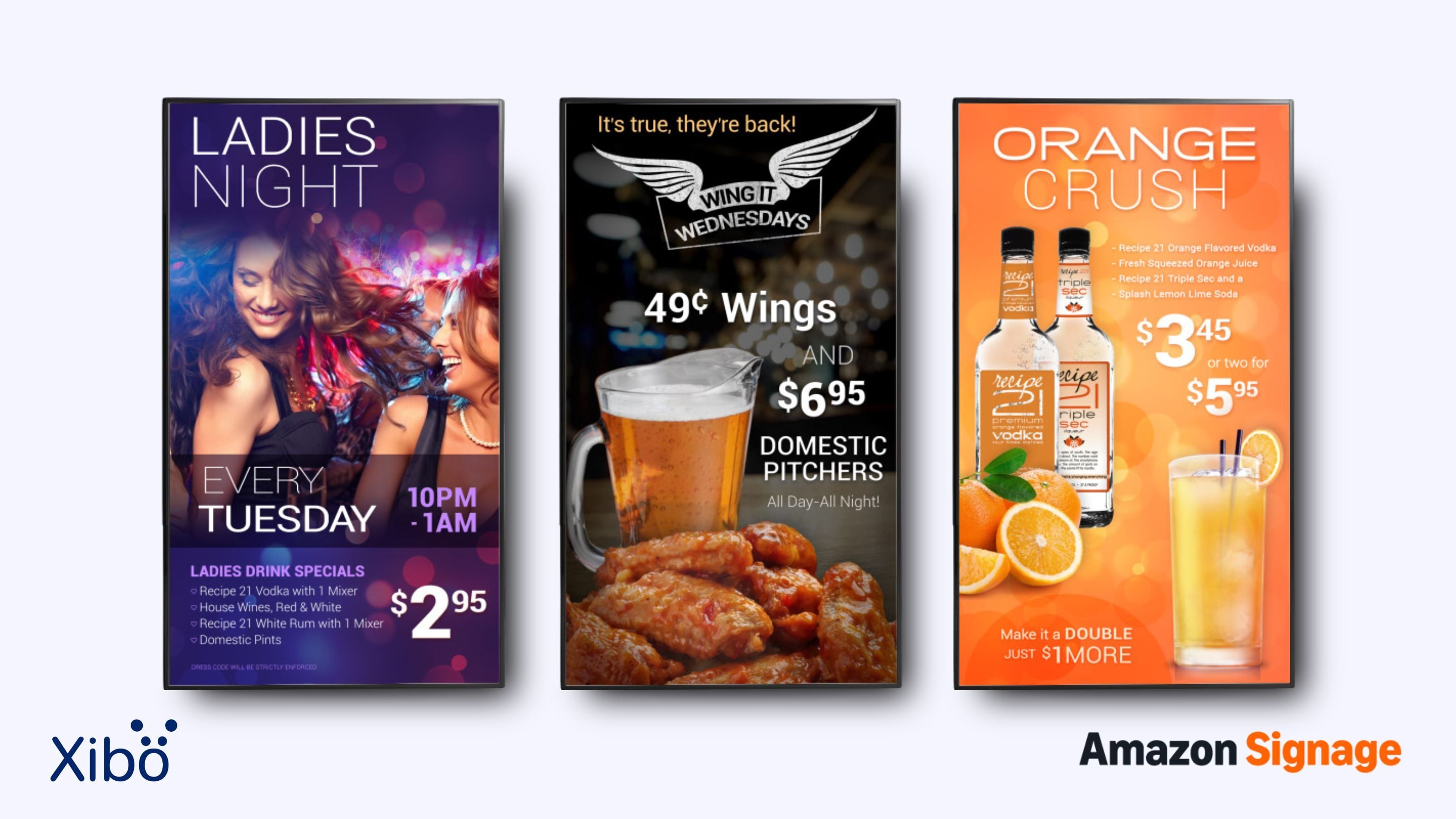
In a quick service restaurant, the menu board is one of the most valuable pieces of real estate in the building. It's where customers make their ordering decisions, so the way information is presented can have a real impact on sales, speed of service and margins. Digital menu boards are now replacing static signage across the sector, and businesses making the switch typically see the return quickly.
Here are some of the key ways digital menu boards can make a difference:
- Faster decisions at the counter: Clear layouts and subtle movement help customers choose quickly, keeping queues moving and nudging larger orders. Build and update boards in minutes with Menu Boards.
- The right products, front and centre: Give higher-margin items, promotions and new products more visibility, and change what's featured without redesigning or reprinting a thing, down to the individual item with Menu Board Products.
- Menus that follow the day: Breakfast items retire when lunch starts, happy-hour offers run to the minute, and seasonal promotions switch automatically. Dayparting handles the transitions with no staff intervention.
- Every location, always current: Manage changes centrally and push a new price or promotion to every site at once, targeting locations by group with Display Groups so nothing goes out of date or out of sync.
- A smoother collection and pickup: Keep waiting customers informed with regular order-status updates pulled automatically from your systems using DataSets.
- None of the hidden print costs: Printing, replacing and correcting static menus quietly eats time and margin. Digital removes the reprint cycle, and getting started can be as simple as a Xibo-certified Amazon Signage Stick.
Digital concierges and lobby displays in hotels
The guest journey in a hotel is longer and more varied than in a QSR, so the information guests need changes throughout their stay. A well-planned display network puts the right information in front of guests at the right moment, without relying on staff to field every question.
- A stronger first impression in the lobby: Set the tone on arrival with a welcome display that carries live local weather, events and property updates alongside your branding. Pull it all from your existing data sources with DataSets so it stays current without anyone touching it.
- Wayfinding that answers before guests ask: Direct guests to the restaurant, spa, meeting rooms or pool with a standing directional layer over your content, so the front desk stops being the first port of call in larger, multi-floor properties. Built with schedule overlays.
- A concierge that's always on: Give guests restaurant recommendations, local attractions and transport details in one place, running as a looping reel in lobbies and lifts. Build and sequence it with playlists so staff can focus on the interactions where a personal touch matters.
- More opportunities to promote services: Surface spa treatments, restaurant bookings and room upgrades where guests naturally spend time, and switch offers by time of day with dayparting so a breakfast promotion gives way to an evening one automatically.
- Clearer communication for events and meetings: Keep daily event schedules and meeting information current outside function rooms, and push last-minute room changes instantly. Connect to your existing systems with DataSets to remove manual re-keying and printed signs.
- Real-time information when it matters: Share transport updates, shuttle times and safety notices across the property the moment they change, using emergency alerts for anything time-critical.
Making digital signage work for your hospitality business
Digital signage once came with the kind of hardware costs and installation demands that put it out of reach for most independent hospitality businesses. More affordable hardware and simpler deployment mean hotels, restaurants and cafes can now use digital displays to answer guest questions, promote services throughout the property and keep their information current without adding to what the team already carries.
Xibo gives hospitality teams the flexibility to manage digital signage across their business. It runs on affordable, plug-and-play hardware that can get a new display running in minutes, while every display and location can be managed from one content management system. A menu change made in the morning can be live across every site by lunchtime, with content scheduled by property, area, time of day or campaign.
That flexibility gives businesses more opportunities to put the right information in front of guests at the right moment, whether that means guiding them from the lobby to the spa, promoting a lunchtime special before they reach the counter or answering the question they were about to ask the front desk. Used well, digital signage becomes another tool for keeping guests happy and taking real pressure off the team.
Getting started with Xibo on the Amazon Signage Stick
For hospitality teams looking to put digital signage into practice, the Amazon Signage Stick provides a simple straightforward way to connect a display to Xibo. It plugs into the display's HDMI port, connects to Wi-Fi and seamlessly integrates to the Xibo CMS, with setup designed to take minutes rather than requiring a specialized AV installation.
A business can use it to reliably power a lobby welcome display, run a digital menu board in a restaurant, support wayfinding across a hotel or replace printed guest information with content that can be updated remotely.
The Xibo CMS supports remote device management for Amazon Signage Stick, helping reduce TCO and make 1-stick-per-display deployments easier to scale. With the native RDM API, teams can manage their entire display fleet remotely from Xibo CMS, without needing to visit each screen on-site.
For a practical guide to planning a digital signage deployment across retail, hospitality, and education, our new eBook, The SMB Guide to High-Impact Digital Signage, covers the key decisions around hardware, content, and measurement.
Purchase the Amazon Signage Stick in your country now:
 US
 Germany
 Spain
 France
 Italy
 UK
 Canada
Frequently asked questions
What is digital signage for hospitality?
Digital signage for hospitality is a secure central hub for managing your guest information, menus, and operational content across your locations. It covers everything from QSR menu boards to hotel lobby displays and wayfinding, giving guests the information they need without adding pressure to your frontline team.
What hardware do I need to run digital signage in a restaurant or hotel?
You need a commercial display and a media player to run the signage software. Xibo provides proven hardware freedom, meaning our Xibo Player App is compatible with a wide variety of rigorously tested and certified devices. We are proud to collaborate with Amazon Signage and the Amazon Signage Stick is a certified device built to simplify digital signage deployment in the hospitality industry. The Amazon Signage Stick helps lower TCO while making 1-stick-per-display deployments easier to manage at scale.
How can digital signage improve the guest experience in hospitality?
Digital signage improves the guest experience by providing accurate, helpful information exactly when it is needed. Displays can display live event updates, promote services, and share dayparted menus automatically, allowing your staff to focus on personal interactions rather than repeating routine information.
Where is digital signage most useful in a hospitality venue?
Digital signage is most effective at key decision points and high-dwell areas such as reception desks, lobbies, restaurants, lifts, and event spaces. The exact placement depends on your venue, but displays are highly effective for welcoming guests, providing directional guidance, and highlighting daily offers.
Can I use an Amazon Fire TV Stick for digital signage?
No, the standard Amazon Fire TV Stick is designed for home entertainment and is not built for commercial use. However, the Amazon Signage Stick is an affordable purpose-built commercial device designed to run digital signage software reliably. It works seamlessly with Xibo out of the box, giving hospitality operators an easy route into digital signage.
How do I purchase an Amazon Signage Stick for Hospitality?
The Amazon Signage Stick is a Xibo-certified signage player, so you buy the hardware directly from Amazon or Amazon Business and run it on Xibo. Order the Stick from your local Amazon Marketplace, US | Germany | Spain | France | Italy | UK | Canada , plug it into your display over HDMI, then activate it through Amazon Signage’s Mobile App or Signage Manager Portal and select Xibo as your CMS during setup. It's a straightforward way to get a lobby or restaurant display live quickly, or to pilot before a wider rollout.